Transfer of office?
The smooth transfer of power in Karnataka has been hailed as a rare display of discipline in contemporary Indian politics.
The Congress on Tuesday firmly denied that its marathon meetings in New Delhi with Karnataka Chief Minister Siddaramaiah and Deputy Chief Minister D K Shivakumar were linked to any impending leadership change in the state, insisting instead that discussions were confined to the upcoming Rajya Sabha and Legislative Council elections.




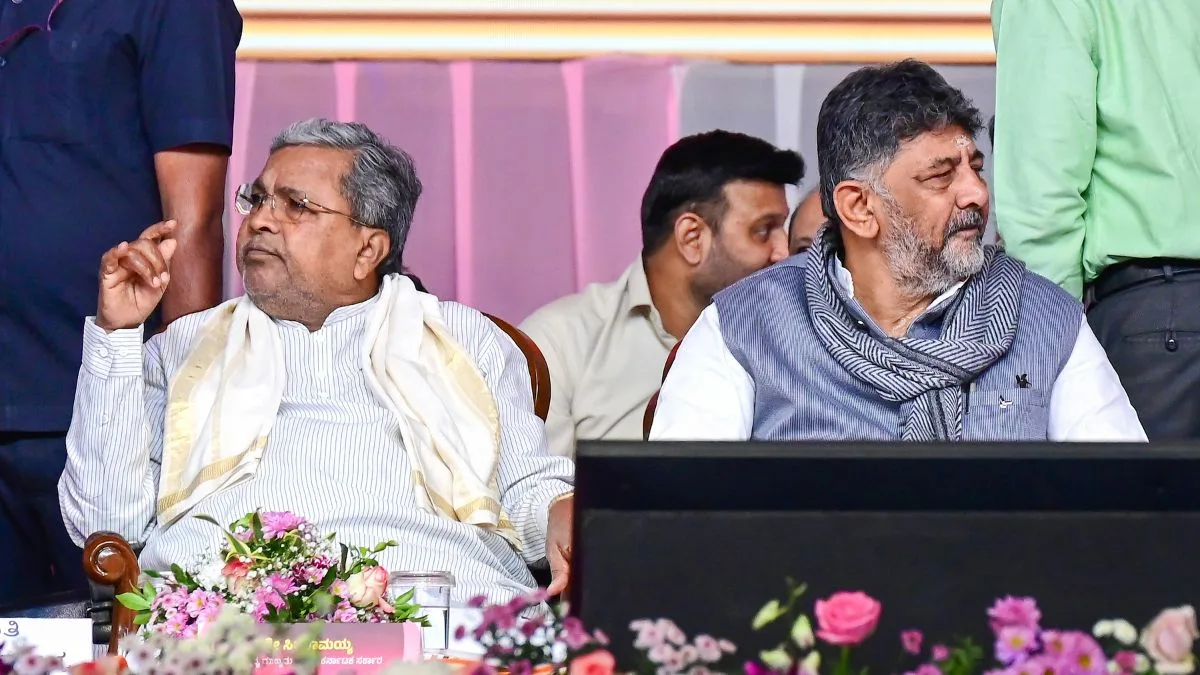
Bengaluru: Karnataka Chief Minister Siddaramaiah and Deputy Chief Minister D.K. Shivakumar at the inauguration of the ‘Suvarna Mahotsava’ under the Integrated Child Development Scheme, in Bengaluru on Friday, November 28, 2025. (Photo: IANS)
The Congress on Tuesday firmly denied that its marathon meetings in New Delhi with Karnataka Chief Minister Siddaramaiah and Deputy Chief Minister D K Shivakumar were linked to any impending leadership change in the state, insisting instead that discussions were confined to the upcoming Rajya Sabha and Legislative Council elections.
The clarification came after nearly six hours of closed-door deliberations involving Congress president Mallikarjun Kharge, senior leader Rahul Gandhi, Congress general secretary K C Venugopal and Karnataka in-charge Randeep Surjewala, amid intensifying political speculation over a possible change in Karnataka’s leadership structure and a Cabinet reshuffle.
Advertisement
Addressing reporters briefly after the meetings, Venugopal sought to shut down the growing political buzz. “Only speculation, no discussions other than on upcoming Rajya Sabha polls,” he said, adding that the meetings focused on the Rajya Sabha and Legislative Council elections in Karnataka as well as organisational matters relating to states including Chhattisgarh, Madhya Pradesh, Rajasthan and Jharkhand. He also advised the media against indulging in “speculation” over the Karnataka leadership question.
Advertisement
Despite the Congress leadership’s categorical denial, the unusually prolonged consultations and a series of one-on-one meetings between the central leadership and Karnataka’s top leaders fueled fresh questions about whether the party is attempting to negotiate a truce between rival camps led by Siddaramaiah and Shivakumar.
The Delhi meetings came at a politically sensitive juncture for the ruling Congress in Karnataka, where persistent rumours about an alleged power-sharing agreement between Siddaramaiah and Shivakumar have resurfaced ahead of the government approaching its midway mark. Supporters of Shivakumar have repeatedly claimed that there was an understanding under which he would eventually assume the Chief Minister’s post after two-and-a-half years, though the Congress high command has never officially acknowledged such an arrangement.
Sources within the party indicated that the Congress leadership reviewed not only preparations for the Rajya Sabha elections but also the broader political climate in Karnataka, including organisational cohesion, governance performance and feedback from legislators. Surjewala is understood to have submitted a detailed report on the functioning of the Siddaramaiah government, concerns regarding anti-incumbency and the impact of prolonged uncertainty over leadership succession.
According to party insiders, the leadership has received feedback suggesting that continued speculation over a transition at the top may be affecting governance and organisational discipline. There are concerns within sections of the party that factional rivalry could undermine the Congress government’s political standing if left unresolved ahead of the 2028 Assembly elections.
Before the formal meetings in Delhi, Siddaramaiah reportedly held a breakfast session at Karnataka Bhavan with ministers considered loyal to him, an exercise widely viewed as a show of strength within the legislature party. The Chief Minister is also believed to have renewed his push for a Cabinet reshuffle, carrying demands from legislators seeking ministerial representation and organisational accommodation.
The reshuffle issue has remained contentious within the Karnataka Congress for months. A large section of MLAs who contributed to the party’s decisive 2023 Assembly victory have been pressing for ministerial berths or greater political responsibilities. However, any restructuring of the Cabinet is politically delicate because it risks disturbing the caste, regional and factional balance carefully maintained within the government.
The Rajya Sabha elections have added another layer of sensitivity to the ongoing negotiations. Karnataka is set to vote for four Rajya Sabha seats on June 18, and the Congress, owing to its strength in the Assembly, is expected to comfortably secure three seats. The selection of candidates is therefore seen as an exercise in balancing loyalty, representation and competing factional interests within the state unit.
Even as the Congress leadership publicly projected unity, the absence of any announcement on either a Cabinet reshuffle or a formal roadmap for Karnataka’s leadership has only deepened political curiosity. State leaders, including Siddaramaiah and Shivakumar, declined to answer questions from the media after the meetings, further adding to speculation that discussions may have extended beyond the officially stated agenda.
The Opposition Bharatiya Janata Party (BJP) has seized upon the developments to attack the Congress government, accusing it of being preoccupied with internal power struggles rather than governance. BJP leaders claimed the ruling party was consumed by “Delhi durbar politics” while key administrative and developmental issues in Karnataka remained unattended.
For the Congress, however, Karnataka carries significance far beyond state politics. It remains the party’s strongest southern bastion and one of the few large states where it governs independently. Any instability in Karnataka could therefore have wider national implications for the party’s attempts to project cohesion and stability ahead of future electoral contests.
The latest round of deliberations in Delhi underscores the balancing act facing the Congress leadership — preserving unity between two powerful regional leaders while simultaneously preparing the party for upcoming electoral battles and ensuring that internal rivalries do not erode its governance record. Whether the meetings ultimately produce a durable political understanding or merely postpone a deeper confrontation remains the central question hanging over Karnataka politics.
Advertisement